是一点 selection algorithm
支持随机查找的数组中找到第 k 大的元素是只需要线性时间. https://en.wikipedia.org/wiki/Median_of_medians
c++ 标准库里面也有类似的算法, std::nth_element
但是他没有返回值, 而是把有 random access iterator
的容器的元素顺序改变了, 保证比第 n 个元素大的都在第 n 个元素前面,第 n
个元素就是第 n 小的元素. 听起来过程和 median of medians 差不多一样,
此时我还不知道 intro sort 这种东西… 于是准备写一个比 nth_element
更快的模板, 有返回值, 不改原来的序列的元素.
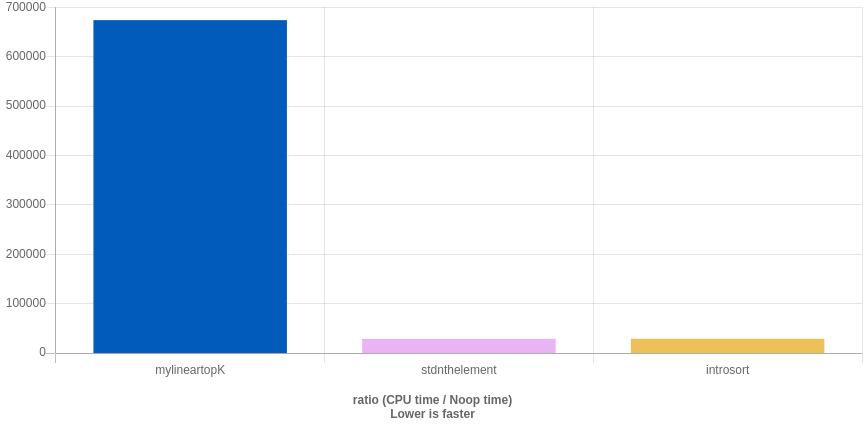
然后…成功成为小丑, 维基百科的 median of medians 抄下来比标准库慢好多…
quickbenchmark
median of medians 是把元素五个一组(一个 5-tuple)找中位数,
然后找到中位数的中位数(pivot). 现在有一半的 tuple 的中位数小于 pivot,
每个 tuple 都有五个元素, 其中两个小于这个 tuple 的中位数, 两个大于这个
tuple 的中位数. 这样我们就知道了, 在 tuple 的中位数小于 pivot 的这些
tuple 里面, 小于等于该 tuple 中位数的元素(每个 tuple
有三个这样的元素)都一定小于 pivot.
也就是说如果我们把个
tuple 都按照他们的中位数大小关系排好序的话, 排在 pivot 所在的 tuple
前面的这些 tuple 里面,有 60% 是一定比 pivot 小的,
他们一定是前半个序列的前 60% 的元素, 同理排在 pivot 所在 tuple
后面的所有 tuple, 每个都有三个元素比 pivot
大,他们一定位于后半序列的最后 60%,
我们每次至少可以扔掉50%*60%=30%的元素(这是最坏情况, pivot
所在 tuple 经过排序之后恰好在第一个或最后一个, 实际上我们不排序!)
注意到选择 pivot 仍然是一个 select 过程, 我们一样可以用这个 median of
median 来做, 非常巧妙
然后再来看看 introsort 是怎么做的
这是stl_algo.h的实现
  template<typename _RandomAccessIterator, typename _Size, typename _Compare>
    _GLIBCXX20_CONSTEXPR
    void
    __introselect(_RandomAccessIterator __first, _RandomAccessIterator __nth,
		  _RandomAccessIterator __last, _Size __depth_limit,
		  _Compare __comp)
    {
      while (__last - __first > 3)
	{
	  if (__depth_limit == 0)
	    {
	      std::__heap_select(__first, __nth + 1, __last, __comp);
	      // Place the nth largest element in its final position.
	      std::iter_swap(__first, __nth);
	      return;
	    }
	  --__depth_limit;
	  _RandomAccessIterator __cut =
	    std::__unguarded_partition_pivot(__first, __last, __comp);
	  if (__cut <= __nth)
	    __first = __cut;
	  else
	    __last = __cut;
	}
      std::__insertion_sort(__first, __last, __comp);
    }
std::__unguarded_partition_pivot找个 pivot,
方法是直接取当前序列的正中间的元素作为 pivot. 然后根据要找的 nth_element
和 pivot 相比哪个大来修改下一步递归的区间.
在 list 比较小的时候就直接用 heap select, 这个函数是这样的:
  /// This is a helper function for the sort routines.
  template<typename _RandomAccessIterator, typename _Compare>
    _GLIBCXX20_CONSTEXPR
    void
    __heap_select(_RandomAccessIterator __first,
		  _RandomAccessIterator __middle,
		  _RandomAccessIterator __last, _Compare __comp)
    {
      std::__make_heap(__first, __middle, __comp);
      for (_RandomAccessIterator __i = __middle; __i < __last; ++__i)
	if (__comp(__i, __first))
	  std::__pop_heap(__first, __middle, __i, __comp);
    }
pop
make_heap
  template<typename _RandomAccessIterator, typename _Compare>
    _GLIBCXX20_CONSTEXPR
    void
    __make_heap(_RandomAccessIterator __first, _RandomAccessIterator __last,
		_Compare& __comp)
    {
      typedef typename iterator_traits<_RandomAccessIterator>::value_type
	  _ValueType;
      typedef typename iterator_traits<_RandomAccessIterator>::difference_type
	  _DistanceType;

      if (__last - __first < 2)
	return;

      const _DistanceType __len = __last - __first;
      _DistanceType __parent = (__len - 2) / 2;
      while (true)
	{
	  _ValueType __value = _GLIBCXX_MOVE(*(__first + __parent));
	  std::__adjust_heap(__first, __parent, __len, _GLIBCXX_MOVE(__value),
			     __comp);
	  if (__parent == 0)
	    return;
	  __parent--;
	}
    }
_GLIBCXX_MOVE std::move, 所有的临时变量都用右值引用存起来,
少了很多复制操作
我好慢…
 2wMZ6VJm_E6787SGdwsQh_mMUOU